24 Haziran 2012 Pazar

Rendering custom data in the Custom Search element

To contact us Click HERE
Last year we introduced Rich Snippets in Custom Search, allowing you to define your own custom attributes that we'll index and return with your custom search results. A few months later we showed you how to render some of these rich snippets in your Custom Search element. Sure, this was a powerful way to let your visitors see thumbnails or interact with the results via actions. But we felt it was still too constrained. It is with great pleasure that today we're announcing that you now have full rendering control of all your metadata in the Custom Search element.

What do I mean? If a picture is worth a thousand words, an example is worth a thousand pictures. Here's a fully customized element, showcasing results and metadata from Scribd.com:
By  -  pages -  views  - last modified 


The results really jump out at you, huh? The thumbnails really help users see what they're looking at, but we've shown you those before. Same with the Download action links by each result. But never before could you include arbitrary, per-result metadata with your Google Custom Search results so easily. Notice the author, length, views and date information in each result. There's even an icon representing each result's document type.

So how can you add this to your page? Let's take a look.

First, you need to include custom attributes within your webpages, either via microformats, RDFa, or a special markup called PageMaps. A PageMap identifies specific attributes that Google recognizes and indexes, and then returns along with search results. Our prior blog post on Structured Custom Search tells you how to add PageMaps to your site. Please keep in mind that your site needs to be re-indexed, which can take some time. Therefore, your PageMaps might not show up immediately.

Once your custom attributes have been indexed, you're ready to tell the element how to render them. If you don't already have the element on your page, you can add it with a few lines:
<script src="http://www.google.com/jsapi" type="text/javascript"></script>
<script type="text/javascript">
// Load the Search API
google.load('search', '1');

// Set a callback to load the Custom Search Control when you page loads
google.setOnLoadCallback(
function(){
new google.search.CustomSearchControl('INSERT-YOUR-ID').draw('cse');
},
true);
</script>
<div id="cse"></div>
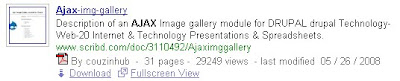
Here's the Scribd.com sample, with only the default rich snippet inclusion:

It looks okay, but let's make it better.

We have to override the default rendering, by adding this line to the onLoadCallback:
google.search.Csedr.addOverride("mysite_");
Now, create a div to hold all of the rendering information - put it right above the div that the element uses:
<div style="display:none">
</div>
Okay, now that everything's set up, it's time for the good part. First off, let's try shrinking the thumbnails a bit. Inside the div that was just added above, and tell the element to render the images at 48x48 pixels:
<div id="mysite_thumbnail">
<div data-if="Vars.thumbnail" class="gs-image-box gs-web-image-box">
<a class="gs-image" data-attr="{href:url, target:target}">
<img class="gs-image" data-attr="{src:thumbnail.src, width:48, height: 48}"/>
</a>
</div>
</div>
This replaces the default thumbnail rendering code with a similar version that sets the image dimensions directly.

Here's the same sample with the above code added:

Now it's time to add the new content and tweak the rendering of the basic content, too:
<div id="mysite_webResult">
<div class="gs-webResult gs-result"
data-vars="{longUrl:function() {
var i = unescapedUrl.indexOf(visibleUrl);
return i < 1 ? visibleUrl : unescapedUrl.substring(i);}}">

<table>
<tr>
<td valign="top">
<div data-if="Vars.richSnippet" data-attr="0"
data-body="render('thumbnail',richSnippet,{url:unescapedUrl,target:target})"></div>
</td>

<td valign="top">
<div class="gs-title">
<a class="gs-title" data-attr="{href:unescapedUrl,target:target}"
data-body="html(title)"></a>
</div>
<div class="gs-snippet" data-body="html(content)"></div>
<div class="gs-visibleUrl gs-visibleUrl-short" data-body="longUrl()"></div>
<div style="& Vars.richSnippet.document">
<img data-attr="{src:Vars.richSnippet.document.filetypeImage}">
By <span data-body="Vars.richSnippet.document.author"></span> -
<span data-body="Vars.richSnippet.document.pageCount"></span> pages -
<span data-body="Vars.richSnippet.document.viewCount"></span> views
- last modified <span data-body="Vars.richSnippet.document.timeAgo"></span>
</div>

<div data-if="Vars.richSnippet && Vars.richSnippet.action" class="gs-actions"
data-body="render('action',richSnippet,{url:unescapedUrl,target:target})"></div>
</td>
</tr>
</table>
</div>
</div>
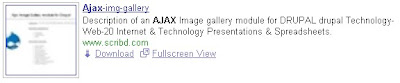
Voila! The sample is now complete, and here's how it looks:

This example is a bit more complex. It shows how to use the render() function to call other code, and also how you can include any JavaScript logic. You can even define internal functions, such as longUrl().

Didn't quite catch all of that or want to do even more? Check out the documentation.

The best part of announcing new features like this is seeing what innovative implementations people come up with. Don't keep us waiting - come show off your handiwork in our support forum or IRC channel!Posted by: David Gibson, Software Engineer and Adam Feldman, Product Manager

Google App Engine Research Awards for scientific discovery

To contact us Click HERE


Since its launch four years ago, Google App Engine has been the platform for innovative and diverse applications. Today, Google’s University Relations team is inviting academic researchers to explore App Engine as a platform for their research activities through a new program: the Google App Engine Research Awards.

These research awards provide an opportunity for university faculty to experiment with App Engine, which provides services for building and hosting web applications on the same systems that power Google’s products and services. App Engine offers fast development and deployment, simple administration and built-in scalability -- it’s designed to adapt to large-scale data storage needs and sudden traffic spikes.

As part of Google’s ongoing commitment to support cutting-edge scientific research across the board, this call for applications welcomes university faculty’s proposals in all fields. Projects may focus on activities such as social or economic experiments, development of academic aids, analysis of gene sequence data, or using App Engine MapReduce to crunch large datasets, just to name a few.

This new award program will support up to 15 projects by providing App Engine credits in the amount of $60,000 to each project for one year. In its first year, the program is launched in a limited number of countries. Please see the RFP for details.

If your research has the potential to advance scientific discovery, generates heavy data loads, or needs a reliable platform for running large-scale apps, we encourage you to submit your proposal. Information on how to apply is available on the Google Research website. Applications will be accepted until 11:59 p.m. PST, May 11, 2012.

Joining forces to support computer science majors

To contact us Click HERE


A few weeks ago, I attended the annual SIGCSE (Special Interest Group, Computer Science Education) conference in Raleigh, NC. Google has been a platinum sponsor of SIGCSE for many years now, and the conference provides an opportunity for thousands of CS educators to come together, share ideas and work on significant challenges that have emerged over the last five years.

Five years ago, the Advanced Placement Computer Science course and exam almost died. Due to lack of student interest, the B part of the AP CS was discontinued and there was a risk that the A part would also be discontinued. At that time, the number of CS majors at the undergraduate level also hit an all time low. Specifically, the number of students taking the AP CS exam fell 15 % between 2001 and 2007, and the number of college freshmen intending to major in CS plummeted more than 70% during the same period. This was a paradox for CS educators. They knew (and know) that advancing U.S. students' understanding of the principles and practices of computing is critical to developing a globally competitive workforce for the 21st century.

Rather than be defeated, a commission of ten secondary and higher education faculty came together and used this as an opportunity to reinvigorate interest in CS. They re-invented the AP CS into a course that not only introduces students to programming, but also gives them an understanding of the fundamental concepts of computing, its breadth of application and its potential for transforming the world.

The NSF generously funded the development and piloting of this new CS Principles course two years ago. This academic year, the NSF has funded several high school pilots as well. The pilots have been so successful that the College Board has now committed to developing a new state-of-the-art exam for the course. This is a critical accomplishment. The AP CS is the only standardized computing course we have in high school. The high school curriculum is packed—it’s nearly impossible to get any new course from any domain into the curriculum, and the AP CS is our stake in the ground.

Concurrent with the AP CS development, the ACM has pushed forward on two fronts that are also making significant impact. The CSTA (Computer Science Teachers Association) now has 11,000 members with 2300 College Board-certified to teach the AP CS Part A (which is still being offered). Membership and interest is rising, and this community plays a key role in professional development, CS standards definition (another critical stake in the ground) and scaling of the new AP CS.

In addition, we have the Computing in the Core Coalition, which is a non-partisan advocacy group of associations, corporations, scientific societies and other nonprofits that is working to elevate CS to a core academic subject in K-12 education. The Coalition does this through advocacy with government agencies and Congress, and by raising general awareness through CSEdWeek.

The good news is we are starting to see positive indicators of change. CS majors are rebounding at the undergraduate level.


The latest Employment Projections for 2010 to 2020 (Bureau of Labor Statistics) show a 6.9% increase in employment from 2006-2010 in computer and mathematical occupations, and a projected 22.0% increase from 2010-2020. This is in comparison to a 14.3% increase, on average, for all other growing occupations.

Students, parents, teachers, administrators and government officials are starting to hear the message:

  • There is an exponentially growing demand in computing job opportunities
  • Computing is inherently creative, innovative and team-based
  • Technology and computing are transforming the world

Of course, we still do not have nearly enough supply coming out of colleges and universities to meet the demand, but the situation has improved in the last two years.

We believe that computing and CS are critical to our future, and we support CS education through many programs including CS4HS, App Inventor (just re-launched from MIT), our Exploring Computational Thinking curriculum, and other outreach programs and partnerships. Computing is at the foundation of all things technology, and computer science is at the foundation of computing.

From Open Research to Open Flow

To contact us Click HERE


Did you know Open Flow has its roots in academia? Back in May 2006 Vint Cerf was visiting Stanford to deliver an invited lecture. Following the talk he met with Stanford Professor Nick McKeown and learned about the Clean Slate Internet project. Nick was looking for support and Google’s involvement in what he described as a lab for “radical new ideas in networking”. Vint felt the program looked “intellectually healthy but might be a very long term matter to bear fruit”. Vint explained that for us to get involved we would want to have Google engineers excited and engaged.

Professor McKeown met with Google networking and infrastructure experts to present his ideas. Everybody knew that Software-Defined Networking (SDN) had great promise but the Open Flow effort seemed a bit ambitious for a professor and a couple of grad students. Googlers Dave Presotto and Stephen Stuart agreed to take a chance on it and sponsor a small research grant to fund another student and to get Google engaged. As Google and the industry got more involved, Open Flow began to gain traction. In June 2008 Google provided another grant to support more students and in late 2009 Google joined the initiatives consortium with other industry members.

Google engineers Stephen Stuart and Jim Wanderer worked closely with Stanford and lead Google’s Open Flow development and deployment. In 2011 the Open Networking Foundation (ONF) was formed to accelerate Software-Defined Networking standards and foster a robust market and ecosystem. Google’s own Urs Hölzle became ONF’s first President and Chairman of the Board.

Google involvement and support of this academic effort was a key factor to the speedy development and deployment of Open Flow and SDN - technology that made it from a university research project to running Google’s WAN in record time.

An Experiment in Music and Crowd-Sourcing

To contact us Click HERE


The Bodleian Library is the main research library at the University of Oxford. It is also one of the oldest libraries in the world, dating back to the 14th century. But the staff of the Bodleian operates very much in the 21st century, using the latest technology to solve their unique problems.

A few years ago, the library acquired a set of 4,000 popular piano pieces from the mid-Victorian period. There’s very little information available on these pieces, so Bodleian staff decided to use crowdsourcing to collect information on this corpus of music. Through a Google Focused Award, they have digitized and made the entire set of music available online.

By visiting the What’s-the-Score website, which opened yesterday, ‘citizen librarians’ can help by describing the scores and contributing to the creation of an online catalogue. They can also include links to audio or video recordings. This is the first time the Bodleian has used this approach to collect catalog information. Typically, a large group of researchers are required to find this information.

Martin Holmes, Alfred Brendel Curator of Music at the Bodleian Libraries, commented: ‘In making the scores available online, they will not only be accessible for academic study and research but will also be there to enjoy for anyone who is interested in various aspects of Victorian music, culture and society.’

The Bodleian Library is one of dozens of recipients of Google Focused Awards. These awards are for research in areas of study that are of key interest to Google as well as the research community. These unrestricted gifts are for two to three years, and the recipients have the advantage of access to Google tools, technologies, and expertise. The Bodleian’s experiment in crowdsourcing to build up data on a specialized collection is timely and interesting, given the number of such collections becoming available on the web.

23 Haziran 2012 Cumartesi

A tribute to Turing, the father of modern computing

To contact us Click HERE
“The past is a foreign country—they do things differently there.” It’s a saying that rings especially true in the world of technology. But while innovating requires us to focus on the future, there are times when it’s important to look back. Today—the 100th anniversary of Alan Turing’s birth—is one such moment.

Statue of Alan Turing at Bletchley Park
Turing’s life was one of astounding highs and devastating lows. While his wartime codebreaking saved thousands of lives, his own life was destroyed when he was convicted for homosexuality. But the tragedy of his story should not overshadow his legacy. Turing’s insight laid the foundations of the computer age. It’s no exaggeration to say he’s a founding father of every computer and Internet company today.

Turing’s breakthrough came in 1936 with the publication of his seminal paper “On Computable Numbers” (PDF).  This introduced two key concepts, “algorithms” and “computing machines”—commonplace terms today, but truly revolutionary in the 1930’s:
  • Algorithms are, in simplest terms, step-by-step instructions for carrying out a mathematical calculation. This is where it all started for programming since, at its core, all software is a collection of algorithms.
  • A computing machine—today better known as a Turing machine—was the hypothetical device that Turing dreamed up to run his algorithms. In the 1930’s, a “computer” was what you called a person who did calculations—it was a profession, not an object. Turing’s paper provided the blueprint for building a machine that could do any computation that a person could, marking the first step towards the modern notion of a computer.
Considering the role computers now play in everyday life, it’s clear Turing’s inventions rank among the most important intellectual breakthroughs of the 20th century. In the evolution of computing, all paths trace back to Turing. That’s why Turing is a hero to so many Google engineers, and why we’re so proud to help commemorate and preserve his legacy.

In 2010, Google helped Bletchley Park raise funds to purchase Turing’s papers so they could be preserved for public display in their museum. More recently, we’ve been working closely with curators at London’s Science Museum to help put on a stunning new exhibition “Codebreaker - Alan Turing’s Life and Legacy.” This tells the story of Turing’s vast achievements in a profoundly moving and personal way, through an amazing collection of artifacts—including items loaned by GCHQ, the U.K. government intelligence agency, never before on public display. Topics addressed include Turing’s early years, his code-breaking at Bletchley Park, his designs for the Pilot Ace computer, his later morphogenesis work, as well as his sexuality and death. The exhibition opened on June 21 and is well worth a visit if you’re passing through London in the next year.


And finally, we couldn’t let such a momentous occasion pass without a doodle. We thought the most fitting way of paying tribute to Turing’s incredible life and work would be to simulate the theoretical “Turing machine” he proposed in a mathematical paper. Visit the homepage today— we invite you to try your hand at programming it. If you get it the first time, try again... it gets harder!

Turing was born into a world that was very different, culturally and technologically, from ours—but his contribution has never been more significant. I hope you’ll join me today in paying tribute to Alan Turing, the forefather of modern computing.

Hundred Zeros for Free eBooks

To contact us Click HERE

Looking for free ebooks? Check the all new Hundred Zeros that went live few hours ago. It’s better and much bigger than the previous version.

hundred zeros - free ebooks

Free eBooks on all Subjects

If you are new, HundredZeros.com is the collection of ebooks that you can read on your computer, your mobile device, your Kindle or inside the web browser itself sans any software.

The site initially launched as Zero Dollar Books but since it may go well beyond ebooks in the future, the site has been rebranded as Hundred Zeros. Here’s what’s new in this release:

  1. You can now browse free ebooks by subject – like Romance, Cooking, History or Travel.
  2. You can find free ebooks on any topic (or by author) using the handy search box – like Shakespeare.
  3. The site uses responsive design and hence should work on all screens.

All you need is a free Amazon.com account and you can read any of these books even without the Kindle device.

For updates, you can follow HundredZeros.com on Twitter and Facebook.

Tweet this Share on Facebook


Digital Inspiration @labnolThis story, Hundred Zeros for Free eBooks, was originally published at Digital Inspiration on 18/06/2012 under Amazon Kindle, Internet.

Related posts:

  1. Write Your Own eBooks in the Browser with Acrobat.com
  2. Download Free Books for your Amazon Kindle
  3. List of Websites That Host Pirated eBooks
  4. Learn How to Create eBooks for the iPad with this O’Reilly eBook
  5. The Kindle Best Sellers that are currently Free